jueves, 25 de abril de 2013

i2Health Sant Pau


i2HealthSantPau within the global network research community

Research is becoming more collaborative, with researchers working together in teams or projects, but their members are often spread over locations far apart from one another. The ability to transfer data and share information together is crucial to productive working in this distributed environment. Science is also becoming more data intensive, with experiments and experimental facilities generating very large quantities of data which need to be stored and/or analysed. 

GÉANT is a flagship project of the EU, key to keeping Europe at the forefront of the global research race. GÉANT is sponsored by the e-Infrastructures Unit of DG CONNECT of the European Commission. DG CONNECT is the Directorate-General for Communications Networks, Content and Technology. Its vision is to make every European digital, and its flagship initiative for achieving this is the Digital Agenda for Europe. DG CONNECT supports ICT research & innovation and deploys regulatory and policy tools in order to boost growth and create jobs.


The GÉANT project is a collaboration between 41 partners: 38 European NRENs, DANTE, TERENA and NORDUnet (representing the five Nordic countries). In total, the project represents 43 NRENs from Europe and nations with FP7 third country agreements. Through the NREN partners, GÉANT delivers a range of services across the network for institutions, projects and researchers.


RedIRIS is the Spanish academic and research network that provides advanced communication services to the scientific community and national universities. I2CAT is connected to the RedIRIS infraestrcure and this way accessing straight to the global reserach community.


At the same time, i2CAT provides value-added research services through the EXPERIMENTA Platform (http://fi2.cat/experimenta). Such platform is a Future Internet test-bed network infrastructure that provides optical transport equipment, wireless and sensor networks as well as provides connection to local stakeholders within metropolitan area of Barcelona through the Industrial Ring (http://www.cesca.cat/en/project/industrial-ring).
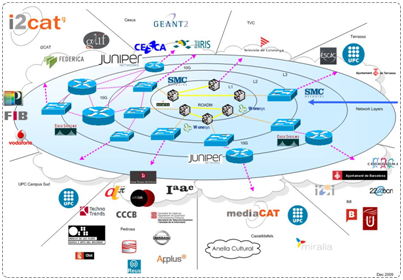


i2healthsanpau Knowledge Centre is connected to the global research community as a node located in the Hospital de Sant Pau enclosure. Such connectivity enables research and innovation activities carried out by the Sant Pau Biomedical Research Institute, Hospital de la Santa Creu i Sant Pau and i2CAT joint venture to interact with the global research community.


Digital services devoted to the health sector are developed in the i2healthsantpau Knowledge Centre and nowadays it counts with the following resources: 


martes, 16 de abril de 2013

Portal del Paciente


Approaching patients and clinicians

Portal del Paciente is an innovative project developed by the eHealth & eInclusion cluster of i2Cat Foundation for the children’s hospital Hospital Sant Joan de Déu. The project is part of the Hospital Líquido initiative from Hospital Sant Joan de Déu that uses the new technologies to attend the patients beyond the physical barriers of the hospital and to promote the dissemination of health knowledge.

The project aims to develop a website where the patients and patient’s parents can communicate with the clinicians and also obtain useful information about their health. The version 1.1 of the Portal del Paciente has been released in February 2013 and includes the following functionalities:

Clinical documentation about the patient:
● Medical Reports
● Image diagnostics
● Laboratory results

Tele-assistance services:
● Online consultation through videoconference
● Tele-consultation through secure messaging
● Tele-monitoring of the patients diabetes

Health contents (text, videos and URLs):
● Generic and useful health information.
● Specially tailored health advice.

The project will contribute to provide a better assistance and follow-up to the patients, while encourages them to be active participants in their health management.


The project is constantly evolving; currently i2Cat is developing the version 2.0 that will include a new Look & Feel, improvements detected during the pilot and also an application to access the portal from a Tablet PC.

miércoles, 10 de abril de 2013

Bariatric Surgery


Virtual Reality Platform for simulate Bariatric Surgery and predict patient evolution

The Bariatric Surgery Project is a multidisciplinary initiative designed and executed by healthcare professionals (surgeons and radiologist) and e-Health researchers. It aims to develop a Virtual Reality platform to support surgeons in prepare and perform the surgery, as well as, estimate patient’s evolution.

The system will retrieve the patient’s abdominal TACs from the Picture Archiving and Communication System (PACS) available at the hospital. From these TACS the system will generate a real 3D representation of the patient’s stomach. The platform will allow the physicians to interact with the 3D model, zoom it, decompose it and finally plan the real surgery simulating it over the 3D model. Also, the platform will incorporate heuristic models providing a prediction of the patient’s weight loss.


After the Surgery will be possible generate new 3D representation of the patient’s stomach, allowing the physicians study the result of the surgery, and preventing post-surgery complications or not expected outcomes.

The system will be integrated with the Hospital information system, allowing retrieving DICOM TACs, the storage of the 3D patient’s stomach model from the PACS and the sending of the patient’s information into his electronic health record (EHR) using HL7 standards.

In addition, Bariatric Surgery project includes a predictive model, which based on previous data from similar surgeries and combined with data of the patient will be able to estimate the evolution.

Currently we are working on collect patients data from previous bariatric surgery interventions for the study, a first prototype of 3D stomach reconstruction, which has been designed and will be tested by using real TACs, and the development of a especial data base for the project and its integration with the Hospital Information Systems.


Website: http://bariatric-surgery.i2cat.net/

Partners:


Funded by Ministry of Economy and Competitiveness, national plan of scientific research, development and technological innovation 2008-2011.

IPT-2011-1377-900000

jueves, 28 de marzo de 2013

Help4Mood

Help4Mood: supporting people with major depression and their clinicians

The European FP7 Project Help4Mood aims to develop a platform to support the treatment of patients with depression, one of the main causes of disability worldwide, in community.


Help4Mood is designed as Personal Health System administered by a clinician that supports the treatment of depression. The platform is structured around patient sessions and focused on monitoring symptoms and engaging the patient in activities base on Cognitive Behaviour Therapy, the most effective non-pharmaceutical treatment for depression.

It collects rich cognitive, psychomotor, and motor data through a Personal Monitoring System and a Virtual Agent, which is then analysed by a Decision Support System; analysis results are fed back to patients and their treating clinicians.


For this ambitious, pan-European project, a consortium of eight partners has joined forces. The University of Edinburgh (Edinburgh, UK), coordinates the project and is responsible for the technical scientific management. Babes Bolyai University, (Romania), is the clinical scientific leader and will be working with clinicians locally and from the University of Edinburgh, Scotland, and the Parque Sanitario Sant Joan de Déu de Sant Boi, Spain. The other partners are Heriot-Watt University (Edinburgh, UK), specialists in creating robust voice interfaces for computer systems, Universidad Politécnica de Cataluña (Barcelona, Spain), experts in biomedical sensing and monitoring, Universidad Politécnica de Valencia (Valencia, Spain), specialists in clinical decision support, FVA (Rome, Italy), an innovative graphics and web design agency, i2CAT (Barcelona, Spain), specialists for interoperability in Healthcare Information Systems, transfer technology and dissemination, and OBSMedical (Abingdon, UK), an international company that provides innovative solutions for telemedicine and eHealth.

For more information, visit the Help4Mood project website (www.help4mood.info) or meet i2cat representatives at the Med-e-Tel 2013 expo and hear about the Help4Mood project in one of the sessions of the Med-e-Tel conference program that will focus on "eHealth & Social Wellbeing".

martes, 26 de marzo de 2013

Design for All Award

The Design for All Award to Life 2.0!!

Design for All Foundation has granted Life 2.0 project with the Living Lab category award during International Design For All Foundation Awards 2013 ceremony, which took place 20th March during International Design Biennial in Saint-Étiene (France). The award has been given to Saara Newton, from our Finland team, during the award ceremony.

The International Design for All Foundation Awards recognise public, private and not-for-profit initiatives from across the world which aim to enable everyone to participate in society on an equal basis. In so doing, they draw international attention to examples of best practice in Design for All.

Life 2.0 is a cofinanced project by the European Commission under CIP ICT-PSP program project, participated by i2CAT’s eHealth area, aiming to improve elderly social interaction through new ICT technologies.

martes, 12 de marzo de 2013

Casals en Xarxa

Connecting elderly people through new technologies

“Casals en Xarxa” (Network of Elderly Activity Centers) aims to connect various elderly activity centers distributed in the Catalonia region (Spain) with a low cost videoconference system. This system is used by the elderly activity centers or “Casals” to jointly participate in activities or to exchange experiences among participants localized in different cities. In addition, the system allows elderly people with any physical impairment that cannot move to the “Casal” to participate in its activities. Home participation is assisted by volunteers who visit these people at their home and is implemented through a tabletPC application.


The project is developed by i2CAT with the support of Welfare and Family Department of Catalan Government and funded by Vodafone Foundation Spain.